 Capsera
YOUR PHARMACOLOGY STUDY DESK
A little practice.A lasting memory.
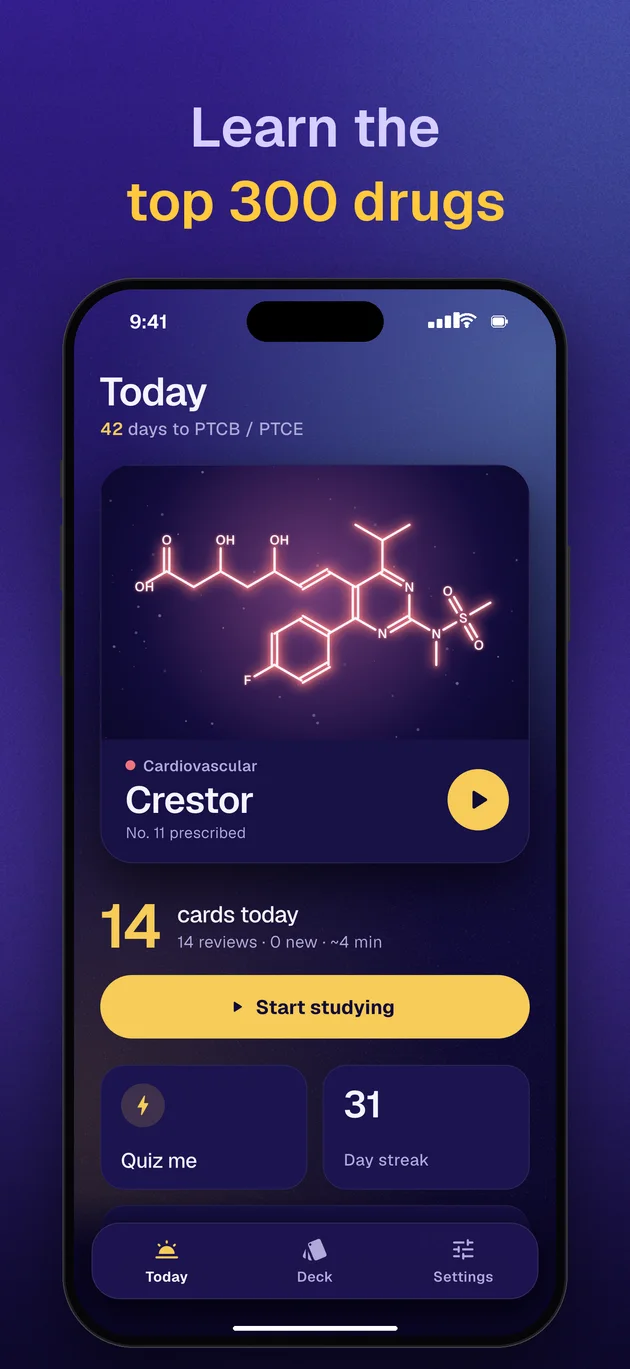
Learn brand and generic names, connect drug classes, and put your recall to work. Start with a short quiz.
Try it here, without an account.
Practice
Try it here, without an account.
Brand and generic drug quiz
Connect a familiar brand name to its generic name. Each answer comes from the study deck, with a link back to the card.
02Generic to brand name quiz
Practice the other direction: find a source-listed US brand for a generic drug.
03Drug class practice
Build connections between generic names and pharmacologic classes.
04Drug uses practice
Review the uses listed on each study card. This is a learning exercise, not a treatment recommendation.
05Mechanism of action quiz
Match a source-based mechanism summary to the drug it describes.
06Your drug study plan
Set a date and a daily study window. Get a simple first-pass target, then use Capsera for due reviews and progress.
07Drug names and class vocabulary
Read selected label passages and connect ten named medicines with class terms. Name endings are memory cues, not a universal classification rule.
08Read boxed-warning passages
Practice locating warning topics in twelve short, source-linked US label excerpts. Open the full warning for its context.
09Read adverse-effect passages
Identify terms in twelve selected US label excerpts. This is source-reading practice, not a complete list of a medicine’s effects.
Choose your study focus
PTCB medication name and class practice
Practice US brand–generic pairs and drug classes, then give difficult names a place in your daily review.
Pharmacology review alongside NAPLEX preparation
Connect a drug’s class, mechanism and listed use in short recall sessions that fit your wider study plan.
Drug recall alongside PEBC qualifying exam study
Build a generic-name and class review routine while keeping Canadian references and the qualifying blueprint in view.
Pharmacology recall alongside GPhC assessment study
Use generic names and source-linked mechanism summaries for a focused review session within your UK study plan.
A nursing pharmacology study routine
Organise medicine names, classes and label vocabulary into manageable study sessions.
Build a daily drug-study habit
Start with a small deck target, review yesterday’s difficult cards and keep a realistic daily study window.
Drug class families
ACE inhibitors
6 Drug cards
Angiotensin II receptor blockers
7 Drug cards
Beta-adrenergic blockers
9 Drug cards
Dihydropyridine calcium channel blockers
3 Drug cards
Non-dihydropyridine calcium channel blockers
1 Drug cards
HMG-CoA reductase inhibitors
5 Drug cards
Proton pump inhibitors
3 Drug cards
Selective serotonin reuptake inhibitors
5 Drug cards
Serotonin-norepinephrine reuptake inhibitors
3 Drug cards
Benzodiazepines
4 Drug cards
SGLT2 inhibitors
2 Drug cards
DPP-4 inhibitors
2 Drug cards
GLP-1 receptor agonists
4 Drug cards
Insulins
6 Drug cards
5-HT1B/1D receptor agonists
2 Drug cards
Direct factor Xa inhibitors
2 Drug cards
Nonsteroidal anti-inflammatory drugs
12 Drug cards
Fluoroquinolone antibacterials
7 Drug cards
Penicillin antibacterials
3 Drug cards
Cephalosporin antibacterials
3 Drug cards
Macrolide antibacterials
2 Drug cards
Loop diuretics
3 Drug cards
Thiazide and thiazide-like diuretics
6 Drug cards
Opioid analgesics
6 Drug cards
Antimuscarinic bladder medicines
2 Drug cards
Alpha-1 adrenergic blockers
5 Drug cards
P2Y12 platelet inhibitors
2 Drug cards
5-alpha reductase inhibitors
2 Drug cards
Dopamine receptor agonists
2 Drug cards
Body systems
Drug libraryCardiovascular
47 Drug cards
Endocrine
27 Drug cards
Respiratory
19 Drug cards
Psychiatry
30 Drug cards
Neurology
18 Drug cards
Pain
16 Drug cards
GI
22 Drug cards
Infectious disease
21 Drug cards
Musculoskeletal
10 Drug cards
Genitourinary
11 Drug cards
Dermatology
18 Drug cards
Eye & ear
19 Drug cards
Hematology
7 Drug cards
Immunology
6 Drug cards
Women's health
12 Drug cards
Allergy
10 Drug cards
Other
6 Drug cards