Happy Bastard Cocktail Recipe
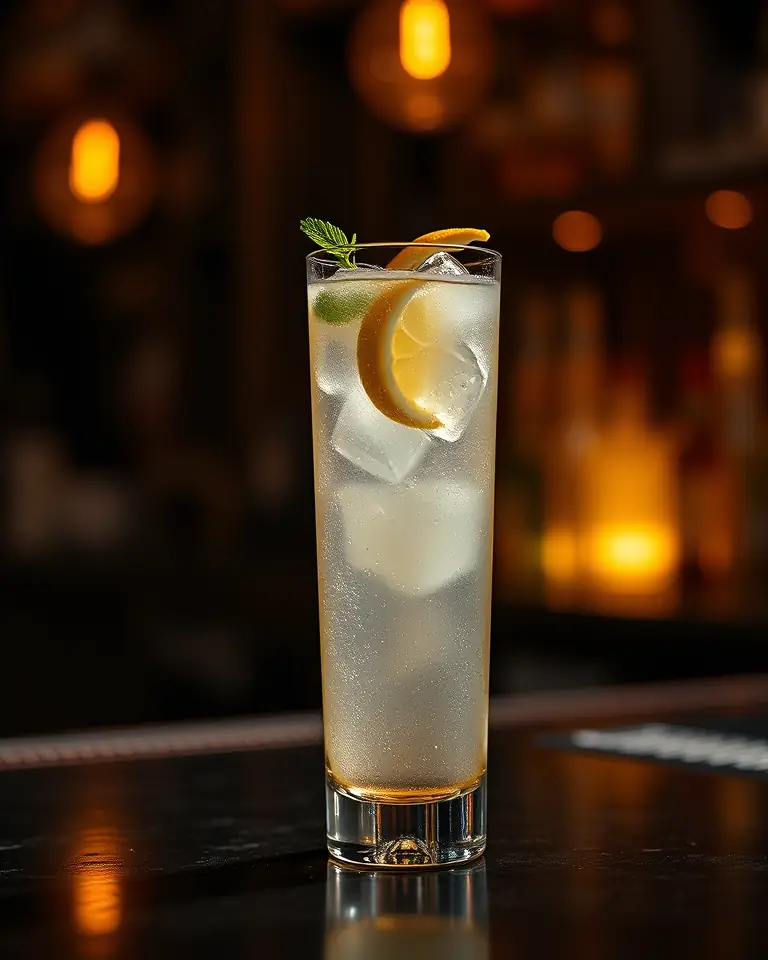
Gin and brandy share a tall glass with ginger syrup, lemon and a little elderflower, lengthened with tonic for a dry, quinine snap.
- Category: Popular
- Glass: Highball glass
- ABV: 13%
- Difficulty: Medium
- Prep time: ~4 min
Ingredients
- Gin30 ml (1 oz)
- Brandy22 ml (0.7 oz)
- Elderflower liqueur7.5 ml (0.3 oz)
- Ginger syrup15 ml (0.5 oz)
- Fresh lemon juice15 ml (0.5 oz)
- Tonic water45 ml (1.5 oz)
All told, 134.5 ml goes into the Happy Bastard before it meets the ice. Split by volume, that is tonic water 33%, gin 22%, brandy 16%, ginger syrup 11%, fresh lemon juice 11% and elderflower liqueur 6%. To make four, measure 120 ml gin, 88 ml brandy, 30 ml elderflower liqueur, 60 ml ginger syrup, 60 ml fresh lemon juice and 180 ml tonic water, 538 ml altogether.
How to Make It
- Add everything except the tonic water to a shaker with ice.
- Shake until well chilled.
- Strain into a highball glass filled with fresh ice.
- Top with the tonic water and stir once, gently.
- Garnish with a lemon wheel.
Garnish
Lemon wheel
The same garnish turns up on 10 other recipes, including Amoxicillin and Pinch Hitter.
What it tastes like
It carries a floral top note and it drinks cool and easy.
The technique
The Happy Bastard goes into the shaker because fresh lemon juice and ginger syrup have to be fully mixed into the rest and chilled hard. Gin is the base of 75 out of 347 shaken recipes in Siplore.
Glass and ice
It is served in a highball glass over ice cubes. 216 other recipes use the same glass; the closest to this one in ingredients are Bright Orchard Gin and Tonic, APB Melrose Gin & Tonic and Room Key, and 74 of them are shaken too.
How strong it is
As served, with the dilution counted, the Happy Bastard is about 13% ABV by the catalogue's estimate. 231 of the 673 alcoholic recipes are lighter and 399 are stronger; the median is 15%.
Ingredient notes and substitutes
- Gin
- 30 ml in this recipe (22% of the liquid). It appears in 127 recipes; 48 of them pair it with fresh lemon juice, as this one does.
- Brandy
- 22 ml here, 16% of the liquid. Across the catalogue: 14 recipes, 3 of which also contain fresh lemon juice. The general name for fruit-distilled spirits; in cocktails it usually means grape brandy. It stands in for cognac, and cognac stands in for it.
- Elderflower liqueur
- This recipe takes 7.5 ml, 6% of the total. Found in 29 recipes in all; the pairing with gin occurs in 12. Elderflower liqueur, such as St-Germain. Floral and sweet; too much of it reads as perfume, which is why recipes rarely go past 15-20 ml.
- Ginger syrup
- 15 ml in this recipe (11% of the liquid). 20 recipes use it, 8 of them together with fresh lemon juice. Ginger syrup — grated fresh ginger steeped with equal parts sugar and water, then strained. In a pinch use ginger beer, but then cut the sugar elsewhere in the recipe.
- Fresh lemon juice
- 15 ml here, 11% of the liquid. It appears in 196 recipes; 48 of them pair it with gin, as this one does. It can swap with lime, but lemon is softer and less aromatic, so use a touch more.
- Tonic water
- This recipe takes 45 ml, 33% of the total. Across the catalogue: 24 recipes, 10 of which also contain gin. Carbonated water made bitter by quinine — that is what separates it from soda. Sugar content varies up to twofold between brands, and that directly sets how sweet the drink lands.
Close relatives
Angie has gin, elderflower liqueur and fresh lemon juice in common with the Happy Bastard (gin: 30 ml here, 60 ml there; elderflower liqueur: 7.5 ml here, 15 ml there; fresh lemon juice: 15 ml here, 22 ml there). Instead of brandy, ginger syrup and tonic water, it takes 22 ml passion fruit syrup. In numbers: 119 ml of liquid against 134.5 ml and 18% ABV against 13%. Angie is served in a coupe.
Hard Sell shares gin, elderflower liqueur and fresh lemon juice with the Happy Bastard (gin at the same 30 ml; elderflower liqueur: 7.5 ml here, 30 ml there; fresh lemon juice: 15 ml here, 22 ml there). In place of brandy, ginger syrup and tonic water it uses 22 ml Malört (Swedish-style wormwood liqueur). The result: 104 ml of liquid against 134.5 ml and 14% ABV against 13%. Hard Sell is served in a coupe.
With the Happy Bastard, Bright Orchard Gin and Tonic has gin, fresh lemon juice and tonic water in common (gin: 30 ml here, 25 ml there; fresh lemon juice: 15 ml here, 10 ml there; tonic water: 45 ml here, 90 ml there). Where this recipe has brandy, elderflower liqueur and ginger syrup, that one has 20 ml apple juice. That gives: 145 ml of liquid against 134.5 ml and 7% ABV against 13%. Bright Orchard Gin and Tonic is built in the glass rather than shaken.
The Story
A lighter-hearted relative of the Suffering Bastard, the gin, brandy, lime and ginger beer drink Joe Scialom devised at Shepheard's Hotel in Cairo in the 1940s.
From the United States the catalogue has 364 recipes; Angie, Hard Sell and APB Melrose Gin & Tonic come nearest to this one.
Frequently asked questions
- How is a Happy Bastard mixed?
- Shaken and served in a highball glass over ice cubes: 5 steps, about 4 minutes.
- How strong is a Happy Bastard?
- About 13% ABV as served. 59% of the alcoholic recipes in Siplore are stronger.
- Can a Happy Bastard be made without alcohol?
- 3 of its 6 ingredients carry the alcohol: gin, brandy and elderflower liqueur. Take them out and only ginger syrup, fresh lemon juice and tonic water would be left. Alcohol-free recipes with a similar profile: Orange Blossom Lemonade and Ginger Turmeric Tonic.
- Is a Happy Bastard hard to make?
- Moderate: 6 ingredients and 5 steps; the steps call for a shaker.
759 recipes in your pocket
Similar recipes
Collections
You will find the Happy Bastard in 2 collections: Gin Cocktails (110 recipes) and American Cocktails (364).
Alcoholic drink recipes are intended for those aged 18 and over. Please drink responsibly.