Art of Choke Cocktail Recipe
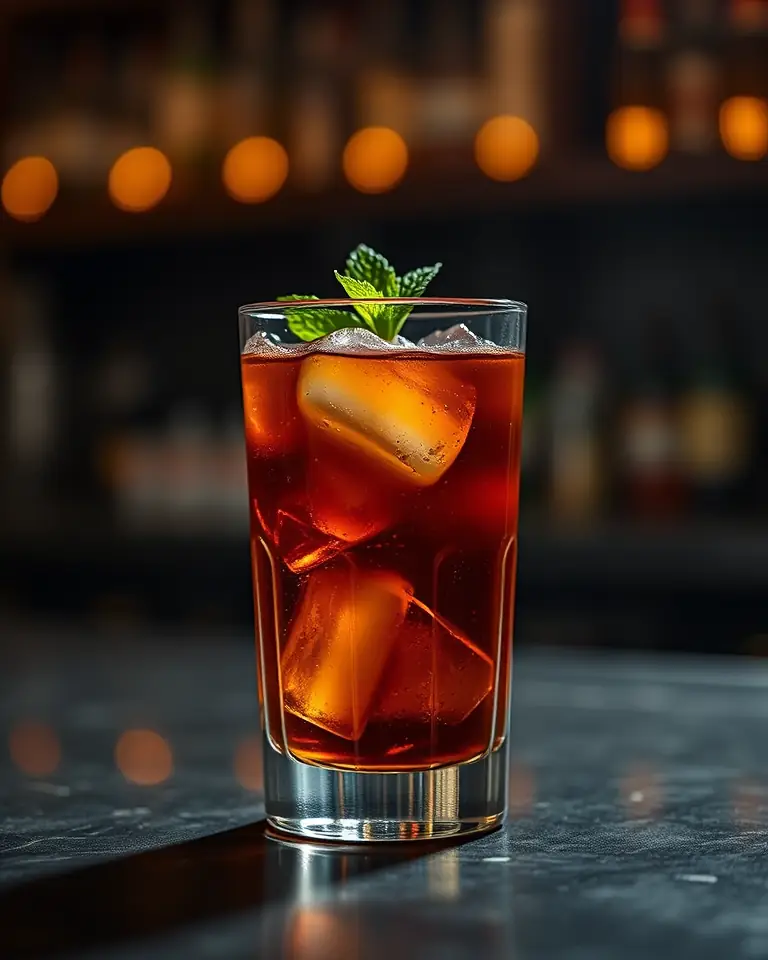
Equal parts white rum and Cynar stirred over bruised mint, with a barspoon each of green Chartreuse and lime: bittersweet, vegetal and cooling.
- Category: Popular
- Glass: Old fashioned glass
- ABV: 23%
- Difficulty: Medium
- Prep time: ~4 min
Ingredients
- White rum30 ml (1 oz)
- Cynar (artichoke amaro)30 ml (1 oz)
- Green Chartreuse1 tsp
- Demerara syrup7.5 ml (0.3 oz)
- Fresh lime juice1 tsp
- Fresh mint leaves1 piece
The Art of Choke comes to 67.5 ml of liquid before ice. Split by volume, that is white rum 44%, Cynar (artichoke amaro) 44% and demerara syrup 11%. On top of that: Green Chartreuse (1 tsp), fresh lime juice (1 tsp) and fresh mint leaves (1). Scaled for four glasses: 120 ml white rum, 120 ml Cynar (artichoke amaro), Green Chartreuse (4 tsp), 30 ml demerara syrup, fresh lime juice (4 tsp) and fresh mint leaves (4) (270 ml in all).
How to Make It
- Lightly bruise a mint sprig in a mixing glass — press, do not shred.
- Add the remaining ingredients and ice, and stir until well chilled.
- Strain into an old fashioned glass over fresh ice.
- Garnish with a fresh mint sprig.
Garnish
Mint sprig
The same garnish turns up on 14 other recipes, including Maracuyá Mojito and Old Haitian.
What it tastes like
It has a bitter backbone, it has a green, botanical backdrop and mint leaves a cooling finish.
The technique
The Art of Choke is stirred even though it contains fresh lime juice; the recipe keeps it smooth rather than frothy. White rum is the base of 3 out of 167 stirred recipes in Siplore.
Glass and ice
It is served in an old fashioned glass over ice cubes. 212 other recipes use the same glass; the closest to this one in ingredients are Kiwito, Canchánchara and Baltimore Southside, and 84 of them are stirred too.
How strong it is
Poured and diluted, the Art of Choke comes out at about 23% ABV in the catalogue. That puts it above the catalogue median of 15%, with 538 recipes lighter and 124 stronger.
Ingredient notes and substitutes
- White rum
- This recipe takes 30 ml, 44% of the total. Found in 52 recipes in all; the pairing with fresh lime juice occurs in 32. The Cuban style is light and dry, the Puerto Rican a little rounder. It is the base of the mojito and the daiquiri; swap in gold rum and the drink turns sweeter.
- Cynar (artichoke amaro)
- 30 ml in this recipe (44% of the liquid). 29 recipes use it, 3 of them together with fresh lime juice. An amaro made from artichoke. It does not taste vegetal but earthy and caramelised; at 16.5% it is one of the lighter amari, which is why it turns up in long drinks.
- Green Chartreuse
- 1 tsp here. It appears in 32 recipes; 20 of them pair it with fresh lime juice, as this one does. The 55% liqueur French monks make from 130 plants. Nothing really tastes like it and nothing really replaces it; yellow Chartreuse is sweeter and 40%.
- Demerara syrup
- 7.5 ml here, 11% of the liquid. Across the catalogue: 22 recipes, 6 of which also contain fresh lime juice. A dark syrup made from demerara sugar. It carries a molasses note, which is why it stands in for simple syrup in whiskey and rum drinks; swapping the other way flattens them.
- Fresh lime juice
- 1 tsp here. Found in 209 recipes in all; the pairing with white rum occurs in 32. If you have none, half lemon and half grapefruit juice comes closest.
- Fresh mint leaves
- 1 in this recipe. 41 recipes use it, 19 of them together with fresh lime juice. The stem is bitter, so use the leaves. One clap between your palms before it goes in releases the oils and gives you the aroma without bruising it.
Close relatives
Kiwi Swizzle shares white rum, Green Chartreuse, demerara syrup and fresh lime juice with the Art of Choke (white rum: 30 ml here, 60 ml there; Green Chartreuse: 1 tsp here, 15 ml there; demerara syrup: 7.5 ml here, 15 ml there; fresh lime juice: 1 tsp here, 15 ml there). In place of Cynar (artichoke amaro) and fresh mint leaves it uses 30 ml pineapple juice and kiwi (1). The result: 135 ml of liquid against 67.5 ml and 14% ABV against 23%. Kiwi Swizzle is muddled rather than stirred, and served in a highball glass.
Marseilles Rhum shares white rum, Green Chartreuse and fresh lime juice with the Art of Choke (white rum: 30 ml here, 22 ml there; Green Chartreuse: 1 tsp here, 22 ml there; fresh lime juice: 1 tsp here, 22 ml there). In place of Cynar (artichoke amaro), demerara syrup and fresh mint leaves it uses 22 ml Bénédictine. The result: 88 ml of liquid against 67.5 ml and 18% ABV against 23%. Marseilles Rhum is shaken rather than stirred, and served in a coupe.
With the Art of Choke, Mojito has white rum, fresh lime juice and fresh mint leaves in common (white rum: 30 ml here, 45 ml there; fresh lime juice: 1 tsp here, 20 ml there; fresh mint leaves: 1 here, 6 there). Where this recipe has Cynar (artichoke amaro), Green Chartreuse and demerara syrup, that one has sugar (2 tsp) and 60 ml soda water. That gives: 125 ml of liquid against 67.5 ml and 12% ABV against 23%. Mojito is built in the glass rather than stirred, and served in a highball glass.
The Story
Created by Kyle Davidson at The Violet Hour in Chicago and spread through the bartender-written booklet Rogue Cocktails; the name puns on Cynar's artichoke.
The catalogue has 364 recipes from the United States; the nearest to the Art of Choke in ingredients are Kiwi Swizzle, Real Charmer's Daiquiri and Maracuyá Mojito.
Frequently asked questions
- How is an Art of Choke mixed?
- Stirred and served in an old fashioned glass over ice cubes: 4 steps, about 4 minutes.
- How strong is an Art of Choke?
- About 23% ABV as served. It is stronger than 80% of the alcoholic recipes in Siplore.
- Can an Art of Choke be made without alcohol?
- 3 of its 6 ingredients carry the alcohol: white rum, Cynar (artichoke amaro) and Green Chartreuse. Take them out and only demerara syrup, fresh lime juice and fresh mint leaves would be left. Alcohol-free recipes with a similar profile: Virgin Mojito and White Grape & Mint Cooler.
- Is an Art of Choke hard to make?
- Moderate: 6 ingredients and 4 steps; the steps call for a mixing glass and bar spoon.
759 recipes in your pocket
Similar recipes
Collections
You will find the Art of Choke in 2 collections: Rum Cocktails (93 recipes) and American Cocktails (364).
Alcoholic drink recipes are intended for those aged 18 and over. Please drink responsibly.