Bywater Cocktail Recipe
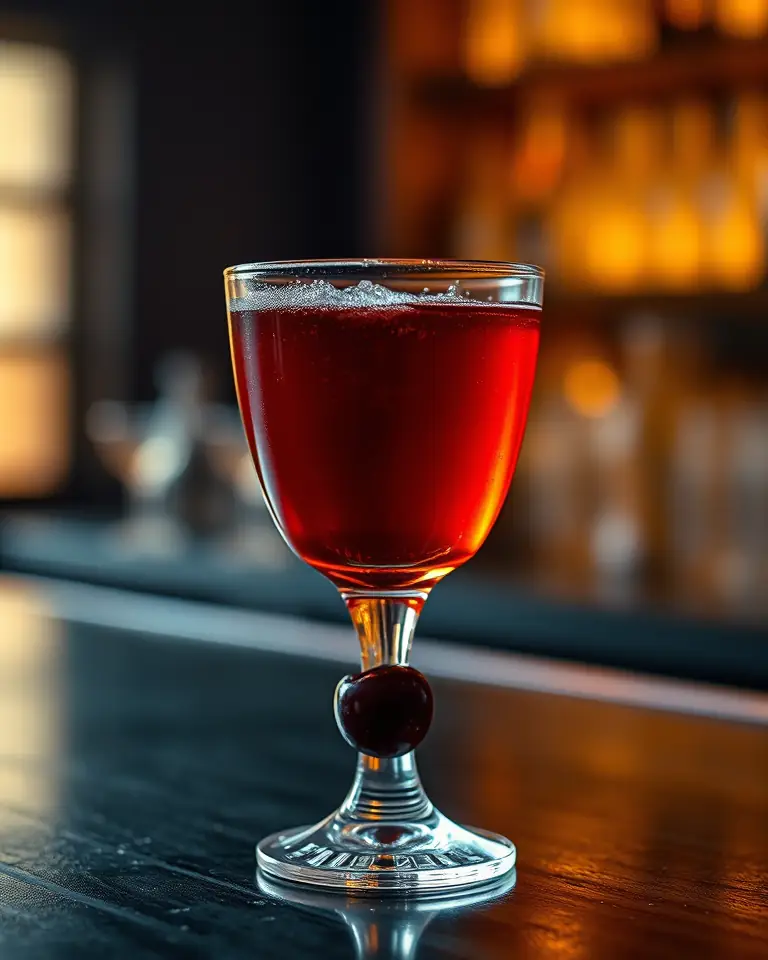
A dark, stirred rum drink layered with amaro, Green Chartreuse and falernum — molasses and spice up front, a long herbal finish.
- Category: Popular
- Glass: Coupe glass
- ABV: 31%
- Difficulty: Medium
- Prep time: ~4 min
Ingredients
- Dark rum52.5 ml (1.8 oz)
- Amaro22.5 ml (0.8 oz)
- Green Chartreuse15 ml (0.5 oz)
- Falernum7.5 ml (0.3 oz)
- Peychaud's bitters2 dash
- Orange bitters2 dash
All told, 97.5 ml goes into the Bywater before it meets the ice. Split by volume, that is dark rum 54%, amaro 23%, Green Chartreuse 15% and falernum 8%. On top of that: Peychaud's bitters (2 dashes) and orange bitters (2 dashes). To make four, measure 210 ml dark rum, 90 ml amaro, 60 ml Green Chartreuse, 30 ml falernum, Peychaud's bitters (8 dashes) and orange bitters (8 dashes), 390 ml altogether.
How to Make It
- Add all ingredients to a mixing glass with ice.
- Stir until well chilled and diluted.
- Strain into a chilled coupe.
- Express an orange twist over the drink and discard it.
- Garnish with a cherry.
Garnish
Cherry; orange twist expressed and discarded
What it tastes like
It has a bitter backbone, it has a green, botanical backdrop, the spirit is right out front and it is layered, giving you something different each sip.
The technique
The Bywater is stirred, not shaken: none of its 6 ingredients is a juice, dairy or egg, so nothing in it needs a shaker's aeration. Of the 167 stirred recipes in the catalogue, 7 are based on dark rum.
Glass and ice
It is strained into a coupe that has been chilled first and served without ice. 182 other recipes use the same glass; the closest to this one in ingredients are Palmetto No. 1, Bijou and Creole Gimlet, and 49 of them are stirred too.
How strong it is
As served, with the dilution counted, the Bywater is about 31% ABV by the catalogue's estimate. Out of 673 alcoholic recipes, 10 are stronger and 655 lighter (median 15%).
Ingredient notes and substitutes
- Dark rum
- This recipe takes 52.5 ml, 54% of the total. It appears in 49 recipes; 6 of them pair it with falernum, as this one does. Barrel-aged dark rum, with molasses, vanilla and treacle in it. Swap in white rum and the drink loses its body, so reach for gold rum instead.
- Amaro
- 22.5 ml in this recipe (23% of the liquid). Across the catalogue: 37 recipes, 5 of which also contain orange bitters. The umbrella name for Italian bitter liqueurs, and no two are alike. Averna is sweet and caramelly, Fernet sharp and minty, Montenegro floral — which is why a recipe naming a brand means it.
- Green Chartreuse
- 15 ml here, 15% of the liquid. Found in 32 recipes in all; the pairing with falernum occurs in 3. The 55% liqueur French monks make from 130 plants. Nothing really tastes like it and nothing really replaces it; yellow Chartreuse is sweeter and 40%.
- Falernum
- This recipe takes 7.5 ml, 8% of the total. 14 recipes use it, 6 of them together with dark rum. A Caribbean syrup-liqueur of lime, clove, ginger and almond. It sweetens and spices at once; a non-alcoholic syrup version also exists, which lowers the drink's strength.
- Peychaud's bitters
- 2 dashes here. It appears in 17 recipes; 3 of them pair it with amaro, as this one does. The New Orleans bitters — anise and rose, and red in colour. It is what a Sazerac tastes of, and swapping in Angostura makes it a different drink entirely.
- Orange bitters
- 2 dashes here. Across the catalogue: 47 recipes, 5 of which also contain amaro. Orange-peel bitters. Where Angostura brings spiced weight, this brings citrus lift; in gin and tequila drinks the two are not interchangeable.
Close relatives
Palmetto No. 1 has orange bitters and dark rum in common with the Bywater (orange bitters at the same 2 dashes; dark rum: 52.5 ml here, 60 ml there). Instead of amaro, Green Chartreuse, falernum and Peychaud's bitters, it takes 30 ml sweet red vermouth. In numbers: 90 ml of liquid against 97.5 ml and 27% ABV against 31%.
Bijou shares orange bitters and Green Chartreuse with the Bywater (orange bitters at the same 2 dashes; Green Chartreuse: 15 ml here, 22 ml there). In place of dark rum, amaro, falernum and Peychaud's bitters it uses 45 ml gin and 30 ml sweet red vermouth. The result: 97 ml of liquid against 97.5 ml and 25% ABV against 31%.
With the Bywater, Black Manhattan has amaro and orange bitters in common (amaro: 22.5 ml here, 30 ml there; orange bitters: 2 dashes here, 1 dash there). Where this recipe has dark rum, Green Chartreuse, falernum and Peychaud's bitters, that one has 60 ml rye whiskey and Angostura bitters (1 dash). That gives: 90 ml of liquid against 97.5 ml and 30% ABV against 31%. Black Manhattan is served in a martini glass.
The Story
Created by New Orleans bartender Chris Hannah as a rum answer to the Brooklyn, and named after the city's Bywater neighbourhood.
The catalogue has 364 recipes from the United States; the nearest to the Bywater in ingredients are Bijou, Black Manhattan and Chartreuse Swizzle.
Frequently asked questions
- How is a Bywater mixed?
- Stirred, then strained into a coupe and served without ice: 5 steps, about 4 minutes.
- How strong is a Bywater?
- About 31% ABV as served. It is stronger than 97% of the alcoholic recipes in Siplore.
- Can a Bywater be made without alcohol?
- All 6 of its ingredients carry the alcohol: dark rum, amaro, Green Chartreuse, falernum, Peychaud's bitters and orange bitters. Alcohol-free recipes with a similar profile: Beetroot & Dill Cooler and Verjuice Sage Spritz.
- Is a Bywater hard to make?
- Moderate: 6 ingredients and 5 steps; the steps call for a mixing glass and bar spoon.
759 recipes in your pocket
Similar recipes
Collections
You will find the Bywater in 2 collections: Rum Cocktails (93 recipes) and American Cocktails (364).
Alcoholic drink recipes are intended for those aged 18 and over. Please drink responsibly.